



Introduction
If you're reading this, you've probably already decided that a laundromat is a business worth pursuing. Now comes the question that will shape everything else: where do you put it?
Most advice on this topic jumps straight to "location is the most important factor" and follows up with a checklist of obvious criteria: demographics, foot traffic, parking, visibility. That advice is accurate as far as it goes, but it's also incomplete. Knowing that demographics matter doesn't tell you how to actually find a space, evaluate whether it can support laundromat operations, or negotiate a lease that protects your investment for the next decade.
Finding the right laundromat space is a process with a logical sequence. Skip steps or do them out of order, and you end up wasting time on spaces that look great from the parking lot but fail on infrastructure, lease terms, or competitive dynamics. Do it methodically, and you dramatically improve your odds of landing a location that performs from day one.
Experienced investors follow a robust location framework outlined below.
The Practical Roadmap to Laundromat Site Selection
The site selection process isn't linear. You'll often be evaluating multiple spaces simultaneously, with some advancing and others dropping off as you uncover new information.
The general flow looks like this:
For investors managing this process independently, the timeline can stretch significantly. The market analysis, infrastructure verification and lease negotiation each require specialized knowledge, and gaps in any one area can mean backtracking to the drawing board after weeks of effort.
Based on LRE's client engagements, working with a dedicated advisor who has the tools, data and industry relationships to properly sequence the process typically compresses the timeline to 4-8 weeks from search to securing an ideal site.
Define What "The Right Space" Means for Your Laundromat
Before you start browsing broker listings or calling equipment distributors, you need to establish your investment parameters. Not every laundromat serves the same customer. Not every space works for every format. The "best" location depends heavily on what kind of business you're building.
A self-service laundromat targeting price-conscious renters in a working-class neighborhood has fundamentally different space requirements than a premium full-service operation with wash-and-fold and pickup/delivery near urban apartments. The first might thrive in a 2,000-square-foot unit in a strip mall with heavy foot traffic. The second might need 3,500+ square feet with a visible storefront on a main road, room for a service counter and dedicated staging space for folded orders.
Location search is downstream of business strategy.
Before reaching out to a distributor or broker, or embarking on a scavenger hunt through online marketplaces, set aside time to develop a robust business plan. This doesn't mean buy a business plan template and fill it in. Spend time to really examine who your ideal customer is and how you want to brand and position your laundromat business to best cater to their needs. Once this is mapped out, you can dive into analyzing potential geographic markets and exploring potential sites.
Questions to answer before you start searching or talking to distributors and brokers
What's your total investment budget? A $250K budget points toward different spaces than a $750K budget. When thinking about budget, it’s extremely important to distinguish between 4 key elements:
- total store value - acquisition price, 75-90% of which will likely be financed
- cash deposit - equity/stake you personally will be investing
- working capital & operating runway - allocate extra reserves to float you while you ramp your store or build out a sustained customer base
- transaction costs & professional fees - all additional costs needed to make a deal happen that are not factored into the acquisition price
What business model are you targeting? Self-service only, full-service with wash-and-fold, pick-up & delivery or a hybrid? Each model has different square footage requirements, layout needs and infrastructure demands. A self-service operation can work in a more compact space. A wash-and-fold operation needs room for processing, staging and potentially separate entrance flows. One may require you to be located in a dense and more expensive city center while the other may open viable options on the outskirts. Don’t attempt to do it all at once - test your core business model first and phase in additional services over time to distribute risk.
Who is your target customer? Price-sensitive families, convenience-focused professionals, college students, or a mix? Don’t lean on ‘mix’ as a safe default. The winning strategy for successful laundromats is tailoring your operation to a specific customer profile. The selected customer profile will dictate the neighborhoods worth evaluating. There's no universal "best" location — there's only the best location for the business you're planning to build.
What geographic area are you focused on? Narrow your target to specific submarkets: particular neighborhoods, zip codes or corridors, not an entire city. Trying to evaluate a full metro or scattered geos at once leads to shallow analysis and decision paralysis. At LRE, we recommend our clients start with a target cluster of 2-3 submarkets and expand from there if needed.
What's your timeline? If you need to be operational within 8 months, that shapes how aggressively you search and what types of spaces you consider. A new buildout typically takes 8-12 months from site identification to grand opening. Buying an existing laundromat can be faster, but you inherit someone else's location decisions and unforeseen hidden costs.
Your responses will become your north star as you proceed in your search. Getting clarity on these questions early can save you 3-6 months during site search and reduce risk of backtracking later on.
Where to Actually Find Laundromat Space
"Find the right location" is the advice. Knowing where to look and how to source the right space is the actual skill.
Traditional laundromat sourcing runs on 2 tracks. The first is public marketplaces: business-for-sale listing sites, business broker sites, Facebook or Craigslist posts. These are easy to search, but a thin slice of available opportunities and often showcase stale listings and deals that have not transacted off-market.
The second track never gets published, and it holds the better inventory for a structural reason. A profitable laundromat with a solid lease and current equipment rarely needs a listing. The owner mentions it to his advisor or distributor rep, qualified buyer surfaces within weeks, deal is inked. Listing publicly costs a broker fee, invites tire-kickers into your financials and tells your employees and customers you may be leaving. Stores that reach a marketplace are often the ones that couldn't clear that first circle of buyers.
Accessing the relationship network where off-market deals move before they go public is where working with a specialized laundromat advisor becomes invaluable.
Business-for-sale marketplaces. BizBuySell, BizQuest, BizScout, FB Marketplace, businessesforsale.com and Baton tend to be the most common starting point since they aggregate all business listings, including laundromats for sale from brokers and individual sellers, but they also tend to be the least fruitful for a couple reasons. Remember - they're built to list every type of business, so performance metrics get reduced to the most generic, surface-level indicators: EBITDA and cash-on-cash return. This tells you very little about whether a specific laundromat is well-positioned or is a sound investment. These platforms offer volume and national exposure, but the listing quality is low. Financials are typically self-reported with no verification, no location or market analysis, and no robust customer demand indicators. According to LRE Research, over the last 6 years, rising attractiveness and valuation of the laundromat asset class has resulted in many deals transacting quickly off-market, while listing marketplaces have become the last resort for deals that are either underperforming or overpriced. In either case, thorough due diligence is recommended.
Laundromats for sale by owner. Plenty of laundromat transactions never involve a broker. Owners post to Facebook Groups or Marketplace, mention it in a regional operator group or to their advisor or sales rep. These are often the top deals, but off-market deal flow moves through channels largely closed to outside buyers so the search process is longer and less straightforward. Fielding dozens of cold inquiries from random buyers is overwhelming to busy owner so it gets a thin response. Priority is often given to calls from a trusted firm that already transacts in that network. When you do find a for-sale-by-owner deal, expect no broker commission in the ask and more room on seller financing, but also unverified financials and zero guidance through the process. Reconcile 24 months of utility bills against reported volume and confirm the landlord will consent to a lease assignment before spending on legal or inspection.
Commercial real estate listing platforms. For investors looking for vacant retail to build a laundromat from scratch, LoopNet and Crexi tend to be useful for gauging market rents and general availability. This can give a solid starting point when evaluating different trade areas and level-setting expectations against market conditions. What CRE platforms will not tell you is whether the immediate market can generate sustained customer demand for a laundromat at that location, whether the lease economics support a 10-year equipment investment, or whether the space infrastructure can accommodate demands of modern commercial laundry equipment. This level of analysis and guidance on site viability is often reserved for dedicated laundromat advisors.
Commercial real estate brokers. Brokers with local market knowledge can be integral to the search and transaction process, especially if you are pursuing a new laundromat build. A well-connected broker or advisor with experience in the laundromat industry can surface viable off-market opportunities and facilitate lease mechanics and even direct landlord outreach. A broker’s specialization and domain expertise are critical - most do not possess the deep laundromat knowledge to source or adequately evaluate site viability for laundromat use. Because a broker’s role is typically transactional with a fee tied to a closing, responsibility for laundromat-specific due diligence, market analysis, financial modeling, equipment procurement, buildout coordination, etc. still fall on the investor.
Direct landlord outreach. You can contact property management companies directly, even without a listed vacancy. Leases expire, tenants leave, and landlords often prefer to fill upcoming vacancies through direct relationships rather than marketing them publicly. Having the backing of an established advisory firm not only adds credibility and weight to these inquiries, but also tends to accelerate response times and success rate compared to cold outreach from private individuals about a space for their laundromat business.
Visiting candidate sites. While driving target neighborhoods is an important verification step, it should not be a sourcing strategy. Site visits are best used to confirm or challenge what the data is telling you about a shortlisted location: property condition, parking adequacy, foot traffic patterns, vacancy levels at the mall or in the immediate market, and whether nearby construction is bringing complementary or competing tenants. As a primary approach, driving doesn't scale and provides only surface-level insights. Most of the factors that determine whether a space is viable for a laundromat are difficult to observe or analyze from a mere drive-by, camp out or even a property tour.
Dark stores. A dark store is a closed down or former laundromat that may retain some original infrastructure. These can potentially offer faster time-to-operation and lower buildout costs, but the first question should always be why the previous operation closed. Sometimes the answer is benign (retirement, neglect). Sometimes it points to market-level problems that haven't changed. Thorough due diligence on closure reasons, infrastructure condition and current market fundamentals is essential. We cover these tradeoffs in more detail in our guide on buying existing vs. building new.

How to Evaluate a Laundromat Market
Once you've confirmed a space can physically support a laundromat, the next question is whether the market around that space can support one profitably. To do this well, you will need to go deep beyond surface-level demographic reports, and explore population shifts and mobility patterns, map out the competition and evaluate your neighboring co-tenants.
Demographics that actually matter for laundromats
Not all demographic data is equally relevant for laundromat site selection. Experienced investors focus on a specific set of indicators:
Renter percentage. This is arguably the single most important demographic indicator. Renters, especially those in multi-family housing without in-unit laundry, are the core customer base for most laundromats. According to Coin Laundry Association data, approximately 87% of laundromat customers live within one mile of the business. Areas with 40%+ renter populations generally indicate strong demand.
Housing age and in-unit laundry prevalence. A neighborhood might have a high renter percentage, but if most apartment complexes have modern in-unit washers and dryers, demand for external laundry services drops significantly. Older housing stock (pre-1990) and multi-family buildings without washer/dryer hookups are strong demand indicators. Buildings constructed before 1985 are especially promising, as retrofitting these older properties with in-unit laundry hookups is often cost-prohibitive for landlords due to inadequate plumbing and electrical infrastructure.
Population density. Most successful laundromats operate in areas with at least 10,000-15,000 people per square mile, though this threshold varies by market. Suburban locations can work if there's a high concentration of target customers within a 1-3 mile radius.
Household income. This is more nuanced than "low income = laundromat demand." The key is correctly matching your pricing and service model to the income levels in your trade area. Moderate-income neighborhoods ($30K-$65K household income) often represent the sweet spot for traditional self-service laundromats. But higher-income urban areas where residents lack in-unit laundry can support premium-priced operations focused on convenience services like wash-and-fold and pickup/delivery, where the primary constraint for the customer is time rather than cost.
Household size and age distribution. Larger households generate more laundry, translating to higher visit frequency and larger loads per visit. Age composition also matters: younger demographics, particularly college students and working professionals, generate significantly more laundry cycles than retirees, and are more receptive to app-based payment and digital booking. A neighborhood near a university campus has a very different demand profile than a retirement community, even at similar population density.
Daytime vs. residential population. Some locations have radically different population profiles depending on the time of day. A strip mall near a large employer campus or office corridor may show strong foot traffic during business hours but weak residential density in the evenings and weekends, which is when most laundromat usage peaks. Understanding whether your location's customer base is primarily residential, commuter, or mixed is essential for matching your operating model and hours to actual demand patterns.
You can access much of this data for free through the U.S. Census Bureau's American Community Survey. Some commercial real estate listing sites like Crexi also surface basic demographic overlays for listed properties.
Beyond the snapshot: tracking demand over time
Static demographic reports show you what a market looks like today. They don't tell you where it's headed. A neighborhood that currently shows strong laundromat fundamentals may be trending in the wrong direction if new apartment developments with in-unit laundry are displacing older housing stock, or if the renter population is migrating to outlying suburbs as property values climb. Conversely, areas experiencing an influx of working-class renters (suburbs absorbing populations pushed out of gentrifying urban cores) may represent emerging opportunities that static data undervalues.
Tracking population shifts, housing development trends and net migration patterns over a 3-5 year window gives you a forward-looking picture of whether demand in a trade area is growing, stable, or eroding. This kind of trend analysis is harder to do than pulling a census snapshot, which is why most investors skip it and why the ones who don't consistently find stronger locations.
Defining your actual trade area
Most guides define a laundromat's trade area as a 1-3 mile radius around the site. In practice, your trade area is shaped by physical geography, not concentric circles. Major freeways, railway corridors, rivers, and even wide, high-speed arterial roads can act as hard boundaries that customers won't routinely cross, even if the distance is short. A competitor 0.5 miles away on the other side of a six-lane highway may not be drawing from the same customer base you are, while a competitor 1.5 miles away with no barriers between you could be your most direct threat.
Understanding where your actual customers would come from, and what physical or psychological barriers define the edges of your market, produces a much more accurate picture of both demand and competition than a simple radius overlay.
Competition: Quality matters more than quantity
Counting the number of laundromats near a potential site is step one. Understanding the quality of those competitors is where real insight comes from.
Visit every competing laundromat within your trade area during peak hours (typically Saturday and Sunday mornings and weekday evenings). Look for:
- Equipment age and condition. Are machines modern and well-maintained, or are they 10-15-year-old top-loaders with "Out of Order" signs? Aging equipment at nearby competitors signals that the market is underserved by modern, customer-friendly options.
- Ownership and management. Is the store owner-operated or run by an absentee owner? Absentee-owned stores with deferred maintenance, inconsistent hours or poor customer experience often indicate a market where a well-run new entrant can capture significant share. Conversely, a hands-on owner-operator running a tight ship is a stronger competitor than the equipment age alone might suggest.
- Capacity utilization. Are machines sitting idle or is there a wait? A competitor running at near-full capacity during peak hours suggests the market can support additional supply.
- Payment systems. Coin-only competitors in a market trending toward card and mobile payments represent an upgrade opportunity for a new entrant.
- Cleanliness, lighting and overall atmosphere. Many laundromats operate at a "good enough" level. A modern, well-maintained store in a market of aging competitors can capture significant market share through customer experience alone.
- Service offerings. Are competitors offering only self-service, or do they have wash-and-fold, pickup and delivery, or other convenience services? Gaps in service offerings represent positioning opportunities.
- Pricing. Document vend prices for comparable machine sizes across competitors. This establishes the pricing baseline for your market and helps inform your revenue projections.
One factor that's easy to miss: stores in the pipeline. Check with the local planning or zoning department for any laundromat permits that have been filed or approved in the trade area. A permitted store that hasn't broken ground yet won't show up on Google Maps or in a neighborhood drive, but it will show up as a competitor 8-12 months from now. A pipeline store could be a positive signal (it confirms market demand) or a negative one (it means you'll be splitting that demand), and evaluating which requires the kind of market-level analysis that's hard to do without laundromat-specific advisory experience.
Co-tenant analysis
The other tenants in your shopping center or strip mall matter more than most investors realize. Complementary co-tenants drive foot traffic that benefits your laundromat. The best neighbors for a laundromat tend to be businesses that attract similar customer profiles on a regular, recurring basis:
- Grocery stores and supermarkets (the top co-tenant for laundromats)
- Dollar stores and discount retailers
- Fast-food restaurants and takeout chains
- Check-cashing and financial services
- Convenience stores and pharmacies
Why grocery stores and supermarkets are top laundromat co-tenants.
Grocery-anchored centers consistently outperform other strip mall configurations for laundromats for a few reinforcing reasons. The customer overlap is nearly 1:1 - renters and families who need laundromat services are the same people making weekly grocery runs. The timing works too: a typical wash-and-dry cycle runs 60-90 minutes, roughly the length of a grocery trip, which makes errand-stacking natural rather than forced. And unlike co-tenants that spike on certain days or hours, grocery stores generate high-frequency, evenly distributed foot traffic throughout the week, which helps sustain your midweek turns, not just weekends.
Less ideal co-tenants include businesses with mismatched customer profiles (high-end boutiques, professional offices) or businesses that create parking competition during peak hours without generating any cross-traffic benefit.
Also consider the anchor tenant's position relative to your space. A laundromat at the far end of a strip mall, 200+ feet from the anchor tenant's entrance, will see noticeably less walk-in traffic than one positioned next to the anchor. Small differences in positioning within a center can have an outsized impact on visibility and walk-in volume.
Laundromat Competitive Positioning and Market Share
You don't need to dominate your market to run a profitable laundromat. You need a clear understanding of how your competitors are positioned and what portion of the addressable customer base you can realistically capture given your location's strengths and their weaknesses.
Not all competitors pose the same threat.
A decrepit, absentee-owned store with aging equipment nearby is vulnerable. Customers will leave for a cleaner, better-equipped, well-marketed alternative without much hesitation. A well-run new store with modern machines, card/app payment and a strong anchor tenant is a strong competitor. Taking customers from that store requires either enough geographic separation or a meaningfully differentiated service offering. Then there's the in-between: a store with newer equipment but poor visibility, limited parking and no strong co-tenants. Harder to steal share from than an aging store, but unlikely to pose a serious threat if you open a better-located, better-operated store with stronger co-tenants.
Market penetration is driven by competitive advantages.
A store with few positive attributes (weak anchor, poor access, low visibility) is more vulnerable to losing customers than one with multiple strengths. Understanding these dynamics for every competitor in your trade area is what allows you to build a data-driven entry strategy and determine the right mix of features, services and amenities for your new location.
So how much of the market do I need to capture?
One useful way to put a number on this is to estimate the portion of the total addressable market (potential customers in the area) your store would need to capture to break even. LRE recommends that a store require no more than 10% market capture to reach breakeven at approximately 3 Turns per Day. Based on LRE's analysis of store performance across markets, if breakeven requires capturing more than 20% of the addressable market, the competitive dynamics are working against you.
Laundromat Infrastructure Requirements: Verify Before You Negotiate
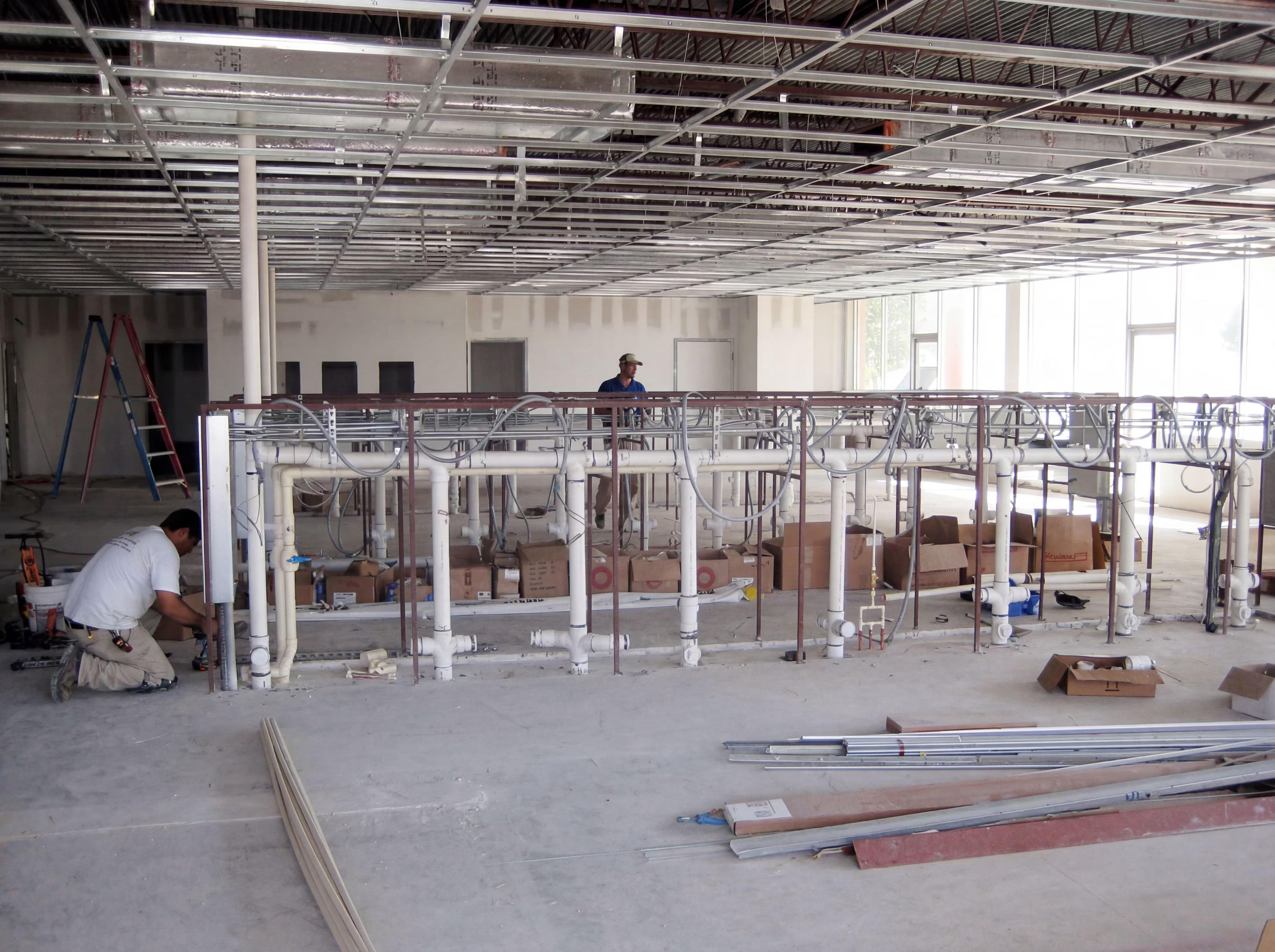
Infrastructure is one of the top deal-killers in laundromat site selection, and the one most new investors don’t give adequate attention. Commercial laundromats have specific utility and structural requirements that need to be verified before committing time to financial modeling, equipment planning or lease negotiation. Some spaces will meet these requirements as-is. Others will have gaps that can be closed cost-effectively with the right landlord and contractor. The goal is to identify which category a space falls into early enough to either negotiate the upgrades into the lease or move on before sinking costs.
LRE recommends the following baseline requirements as you assess key systems for a laundromat:
- Water supply: minimum 2-inch service line for most operations, 3-inch for larger footprints over 3,000 SF.
- Electrical: 400-600 amps, three-phase service. Megastores over 3,000 SF may need 800 amps.
- Natural gas: 1.5-2.5 inch pressurized line for commercial dryers and water heaters. Larger stores may need 3.5in or even 4in gas line.
- Drainage: 4-6 inch main lines with proper gravity slope. Modern high-extract washers dump 15-30 gallons per cycle rapidly; undersized or deteriorated drain lines lead to backups and possible flooding.
- HVAC and ventilation: 1 ton of air handling capacity per 350 SF as a rule of thumb (a 3,500 SF location would need approximately 10 tons, likely two 5-ton rooftop units or RTUs). Each gas dryer also exhausts hundreds of CFM from the building, and the system needs to replace 100% of that exhausted air to prevent negative pressure, backdrafting and lint accumulation.
- Structural slab: if you're planning to use hard-mount machines (which require bolting directly to the floor), the space needs a reinforced concrete slab, typically 6 inches minimum. Not all retail floorplates meet this requirement, and it can significantly narrow your options during site selection.
These systems compound. An undersized water line can trigger a water heater upgrade, which requires a larger gas line, which may need a new meter from the utility company. Verify early. A site visit with a qualified contractor or advisor who understands commercial laundry can determine whether gaps are manageable or deal-killers before they become sunk costs.
Laundromat-Specific Lease Negotiation
The buildout and operational requirements of commercial laundromats are materially different and more intensive than most retail tenants. Correspondingly, the lease terms must be given more thorough attention in order to avoid common risks to your investment.
"Most people don't realize how much leverage you actually have in a lease negotiation, especially if you're committing to a long-term lease and bringing a stable, recession-resistant business to the property. Laundromats are attractive tenants for landlords because they generate consistent foot traffic, operate on long lease terms and rarely default. That's leverage you should be using at the negotiation table." — Nick Grant, Project Manager, LRE Advisors
Most first-time investors focus primarily on the monthly rent. That's important, but it's not even close to the full picture. These are the lease provisions that experienced laundromat operators prioritize:
5 Key Lease terms To Review
Lease term length and renewal options.
Your equipment's useful life is 10-15 years and your payback period on the initial investment might be 3-5 years. A 5-year lease with no renewal options leaves you exposed. Target a 10-year initial term with two 5-year renewal options, or at minimum a 7-year term with renewal rights.
Tenant improvement (TI) allowance.
TI allowances (cash contributions toward your buildout costs) for laundromat tenants can range from $10 to $40+ per square foot depending on the market, other lease terms, tenant's profile and business model, the landlord's motivation and how long the space has been vacant. Negotiate TI early. A 15-year lease commitment typically unlocks significantly higher TI than a 7-year term.
Free rent period.
Most commercial leases for new buildouts include a period of free or reduced rent during construction and initial ramp-up. You shouldn't be paying full rent while the space is under construction and generating zero revenue. Typical range is 6-12 months depending on market conditions and your negotiation position. Some landlords structure this as "conditional free rent" that becomes payable if you break the lease early.
Rent escalation caps.
Annual rent increases are standard in commercial leases, but the structure matters. Uncapped escalations tied to market rates can surprise you in year 5 or 8 when rents in a hot market have climbed 30-40% above your starting rate. Negotiate fixed annual escalations (typically 2-3% per year) or CPI-linked increases with a cap. Predictable rent increases allow you to plan your financial model with confidence.
Personal guarantee.
Most landlords will require a personal guarantee, which puts your personal assets at risk if the business fails. If you're financing through an SBA loan, the lender will also require one for anyone with 20% or more ownership. On the landlord side, this is negotiable. Standard structures like burn-off provisions (the guarantee reduces or expires after consistent on-time rent payments) or Good Guy clauses (your liability ends when you vacate in good condition) can limit your exposure without being a dealbreaker for the landlord.
Additional provisions to negotiate
- Permitted use: verify the lease explicitly allows laundromat operations, including commercial equipment, water usage levels and signage.
- Utility responsibilities: clarify who pays for water, sewer, electrical and HVAC infrastructure upgrades. These costs are significant and ambiguity leads to disputes during buildout.
- Exclusivity clause: an exclusivity provision prevents the landlord from leasing to another laundromat or laundry service in the same property. While unlikely that a competing operator would open next door, it's a worthwhile provision to secure, especially given the scale of your buildout investment.
- Assignment and transfer rights: ensure the lease is assignable with reasonable consent provisions so you can sell the business. Upon successful transfer, the original tenant and guarantors should be fully released.
- Restoration clause: standard leases require restoring the space to original condition at lease end. For a laundromat, that means ripping out plumbing, electrical and concrete work. Negotiate an explicit exclusion for permanent infrastructure.
- Landlord consent for equipment financing: equipment lenders will not disburse funds unless the landlord signs a lien waiver acknowledging the equipment belongs to the tenant or lender, not the landlord. Address this before closing.
Analyze the in-place lease terms when buying an existing laundromat business
If you're acquiring an existing laundromat, scrutinize the lease with the same rigor you'd apply to a property inspection. Check remaining term and renewal options, escalation clauses, exclusivity provisions and assignment language.
A store generating $15K/month on a lease that expires in two years with no renewal options might present a noteworthy investment risk. In fact, if planning to finance the business acquisition with an SBA loan, you will likely be required to produce a negotiated lease with a 10 year term or at minimum the term to repay the loan.
In some cases, landlords may try to pass deferred maintenance liability to the new tenant via a net lease - this is a big red flag. A bad lease can cost you your business regardless of how well the machines are projected to perform or how good the location is.
If the location and financials make sense, the lease may be worth negotiating. In other cases, it may be prudent to walk away.

Laundromat Deal-Killers: Know When to Walk Away From a Space
Not every promising site will work. Knowing when to walk away early is as important as knowing what to look for.
- Zoning doesn't permit laundromat use and the variance is uncertain. Conditional use permits put you at the mercy of planning boards and neighbor objections, adding at least 3-6 months with no guarantee of approval. Find a space where laundromat use is already permitted.
- Infrastructure upgrades may not be viable or permitted. If a building needs a full water service upgrade or additional RTUs for proper ventilation, the all-in investment may exceed what the location can reasonably support. Not all landlords will allow certain modifications like trenching or core drilling.
- The lease term doesn't protect your investment. A 5-year term with no renewal options on a buildout that requires 7+ years to recover doesn't work, regardless of how attractive the location is. Remember - renewal options do not guarantee lease extension. Check all lease termination provisions carefully.
- A dark store closed due to market fundamentals. Demographic shifts, competitor oversaturation or declining population density don't resolve themselves. Verify through thorough market analysis. Sometimes "poor prior management" is a marketing cloak for bigger systemic issues.
- Parking is inadequate. Whatever the reason may be for lack of parking, if your customers can’t park they will go elsewhere. Target approximately 4 spaces per 1,000 SF with close proximity to your entrance.
- An existing store's lease doesn't support the acquisition economics. If the remaining term is shorter than your payback period, renewals are uncertain, or escalation clauses are uncapped, the cash flow you're buying may not survive the next lease cycle. Walk away, or renegotiate the lease as a condition of the acquisition.
The cost of pursuing a fundamentally flawed location or inheriting a lease that works against you is always higher than the cost of resuming your search.
Laundromat Site Selection: FAQ
How do I find laundromats for sale by owner?
Most for-sale-by-owner (FSBO) laundromats never reach a listing platform like BizBuySell which is also what makes them hard to reach from the outside. These are also frequently the strongest deals available. Store owners typically mention it to their advisor or sales rep, and sometimes other peer operators they might know. Direct outreach to owners in your target trade area is a legitimate method, but busy operators field dozens of these weekly and most inquiries go unanswered. Calls from a trusted firm already connected with these operators get further. When you do land a FSBO deal, expect unverified financials and no guidance through the process, so front-load diligence: 24 months of utility bills reconciled against reported volume, full lease review and written landlord consent to assignment or a new lease.
How much space do I need for a laundromat?
The answer will largely vary with your market, business model and service needs. As a starting baseline for a typical laundromat, LRE recommends around 3,000-3,500 square feet, which should allow you to fit a versatile mix of machines with adequate circulation and even some amenities. A self-service-only operation with 20-30 machines typically requires 1,500-2,500 square feet. Adding wash-and-fold or additional services may call for 2,500-4,000+ square feet to accommodate processing areas, folding stations and service counters. Larger megastores with multiple services and amenities can run 4,000-5,000+ square feet. Remember to plan for adequate parking proportional to the size of your store - don’t let parking cap your operations.
Can I open a laundromat in any commercial space?
No. Laundromats require specific commercial zoning and may require additional permits or conditional use approval depending on local ordinances - check with your local city planning office. The space also needs to meet or be upgradable to the infrastructure requirements for commercial laundry equipment: 2-3 inch water service, 400-600 amp three-phase electrical, properly sized drainage and gas lines and adequate HVAC. Some spaces meet these requirements as-is. Others are non-starters. Sometimes infrastructure gaps can be closed with the right contractor, but be sure to discuss everything with the landlord first before entering into a lease.
What infrastructure does a laundromat require?
Infrastructure requirements for a commercial laundromat are much more demanding than typical retail:
- Water supply - minimum 2-inch service line, 3-inch for larger footprints
- Electrical capacity - 400-600A three-phase; up to 800A for large stores
- Natural gas - 1.5-2.5 inch pressurized line for dryers and water heaters; up to 4in for large stores
- Properly sized drainage - 4-6 inch lines with gravity slope
- HVAC capacity - 1 ton per 350 SF with adequate makeup air to replace dryer exhaust
- Structural slab - Hard-mount machines require a reinforced concrete slab to be bolted directly to the floor
Check with the landlord if they will permit any required work.
Should I use a commercial real estate broker to find laundromat space?
Brokers are useful for sourcing available spaces, occasionally surfacing off-market opportunities and facilitating lease negotiation. The limitation is often lack of specialized laundromat knowledge and a largely transactional relationship (lease is signed, fee is paid). A real estate broker will not support you through the full project, and may not be able to surface laundromat-specific issues or bring spaces that are ideally suited for a laundromat. Understanding the limitations of the brokerage relationship is important, so you can adequately plan and coordinate your project without delays or costly surprises.
How long does it take to find and secure a laundromat location?
Laundromat search timeline depends heavily on how the process is managed. DIY site selection comes with a longer, less predictable timeline, sometimes taking as long as 12-18 months. This lengthy process is often a result of gaps in market data, poorly defined criteria, infrastructure surprises and negotiation setbacks that can mean backtracking and restarting your search. Working with a dedicated advisor with the data, tools, industry insights and vendor relationships can compress the timeline to 4-8 weeks from active search to secured site. From there, plan for 4-8 weeks of lease negotiation and due diligence, and 6-9 months of permitting and buildout before opening.
What's the difference between finding space for a new laundromat vs. buying an existing one?
A new buildout gives you full control over location selection, equipment, layout and brand, but requires a longer development timeline (typically 8-12 months from site identification to grand opening). Buying an existing laundromat may shorten the time to cash flow, but you inherit the previous owner's location decisions, have less leverage in lease negotiation with less favorable terms and depending on the state of equipment and infrastructure, may face costly repairs, maintenance and retooling shortly after acquisition. Both paths require thorough due diligence, just on different things. For a detailed comparison, see our guide on whether to buy an existing laundromat or build new.
How important is foot traffic for a laundromat?
Less than most people assume. Laundromat customers don't make impulse visits. They come with a specific purpose and usually from within a 1-2 mile trade area. Visibility from the road and ease of access (especially convenient parking) tend to matter more than raw foot traffic. That said, locations in shopping centers with strong co-tenants like grocery stores do benefit from errand-combining behavior, so evaluate the performance of nearby stores and pay attention to the development pipeline.
How much does a laundromat lease typically cost?
Base rents vary widely by market. Monthly rent is only one component of a laundromat lease. Investors should evaluate all terms in unison to get the full picture and make an informed decision on whether to negotiate (and how) or walk away: term length (target 10+ years to protect your equipment investment), TI allowances ($10-$40+/SF varying based on many factors listed in the article), free rent during buildout (6-12 months is common), escalation caps (target fixed 2-3% annually), personal guarantee scope, and utility upgrade responsibilities. If you're acquiring an existing store, the in-place lease demands equal scrutiny: remaining term, renewal options, assignment rights and exclusivity provisions all affect the real value of the business.