



Introduction
Most people picture starting a laundromat business as rows of coin-operated machines, flickering fluorescent lights, and that distinct smell of detergent. This is quickly becoming an outdated image of the laundry industry, which is currently undergoing rapid transformation.
The modern laundromat business is founded on data-driven location search and store optimization strategies, sophisticated revenue models, technology-enabled, automated operations and a new focus on user experience. These are all key factors in gaining a competitive edge and securing steady revenue, which for many successful laundromats can equate to 20-35% cash-on-cash returns.
Respect the capital. Respect the process.
Starting a laundromat is a real investment that requires real diligence across multiple disciplines: real estate analysis, financial planning, space design, equipment mix/layout planning and procurement, architect and construction management, and a robust marketing strategy to drive post-opening growth. If you are just starting out, casually driving by potential locations one weekend every few months isn't going to cut it.
Your success will demand a methodical process and allocating adequate time, attention, effort and capital throughout the entire journey of opening your first laundromat business.
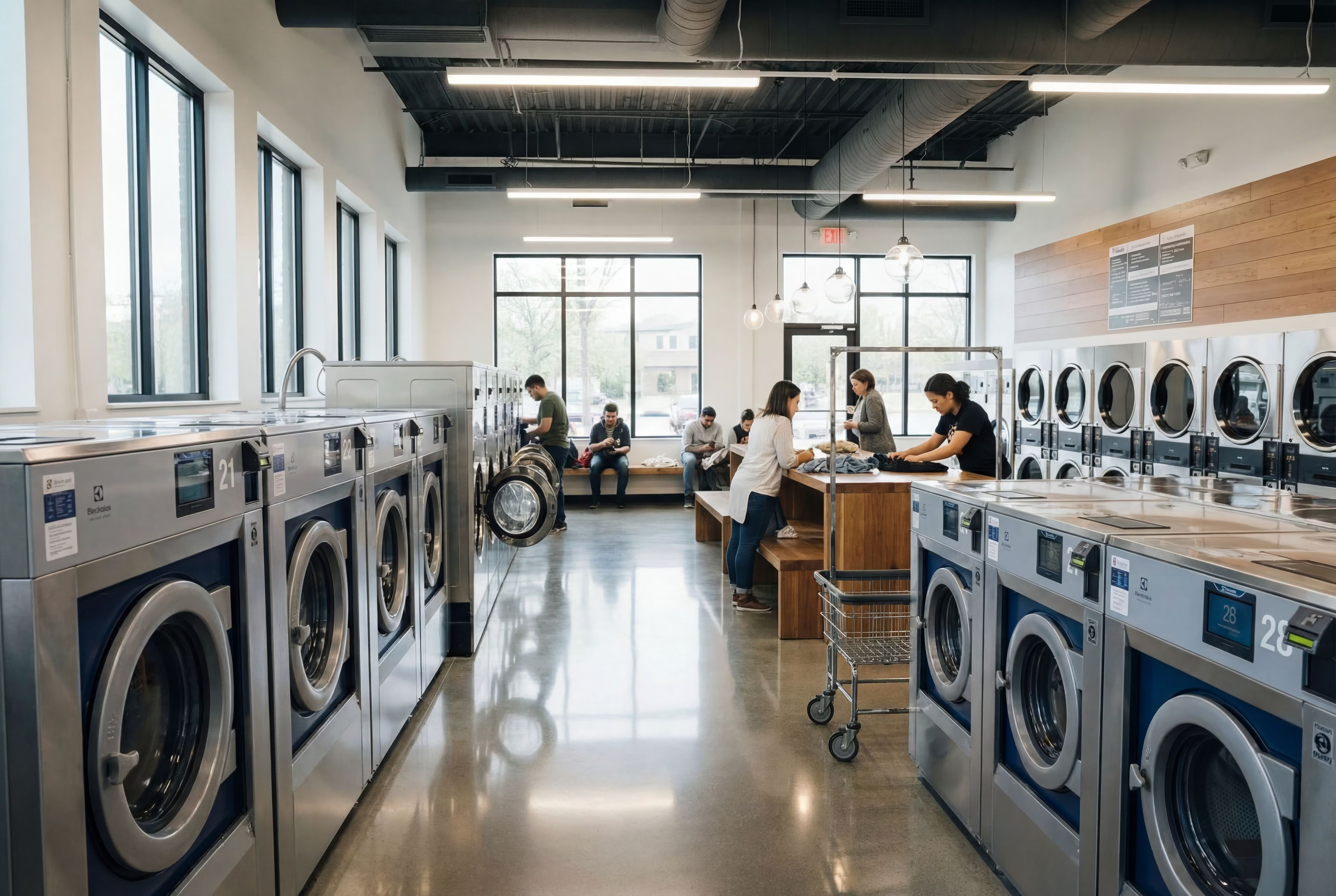
It's not uncommon for today's successful laundromat owners operating high-performing stores to see 20 to 35 cents back in pure profit each year for every dollar invested. This level of ROI comes from building next-generation laundromats that prioritize efficiency, superior customer experience, and continuous optimization based on aggregated data including turns per day, average spend, utility consumption, and dozens of other performance attributes.
The modern laundromat owner is an operator who leverages market analysis, integrated multiple revenue streams, and employ technology solutions to benchmark their own stores performance. This approach has transformed coin laundromats from basic service providers into sophisticated businesses that serve diverse customer needs and are well positioned for sustainable growth.
The laundromat industry has seen significant evolution, and while the potential for strong returns exists, success requires understanding that you're building a business, not purchasing a passive investment. The most successful operators treat their laundromats as dynamic enterprises that benefit from attention, optimization, and strategic thinking—especially during the critical first few years.
- Nick G.
What Does It Actually Cost to Open a Laundromat?
According to our recent evaluations of newly launched stores across major US markets, realistic investment requirements for new laundromat construction during 2025 typically range from $700,000 to $1 million, with the average project cost around $950,000.
To be clear, this is the all-in full project cost estimate, but it does not mean you need to have this amount in your pocket. Most likely you'll need to apply for financing, which will help you secure 75% of the funds. This means you will still need to come up with a 25% in cash/equity to show lenders you have skin in the game and are serious about opening a laundromat business.
The breakdown of laundromat startup costs
This investment typically breaks down into two primary categories, with equipment representing the substantial portion of your capital allocation. Understanding this breakdown helps in planning your financing strategy and cash flow requirements.
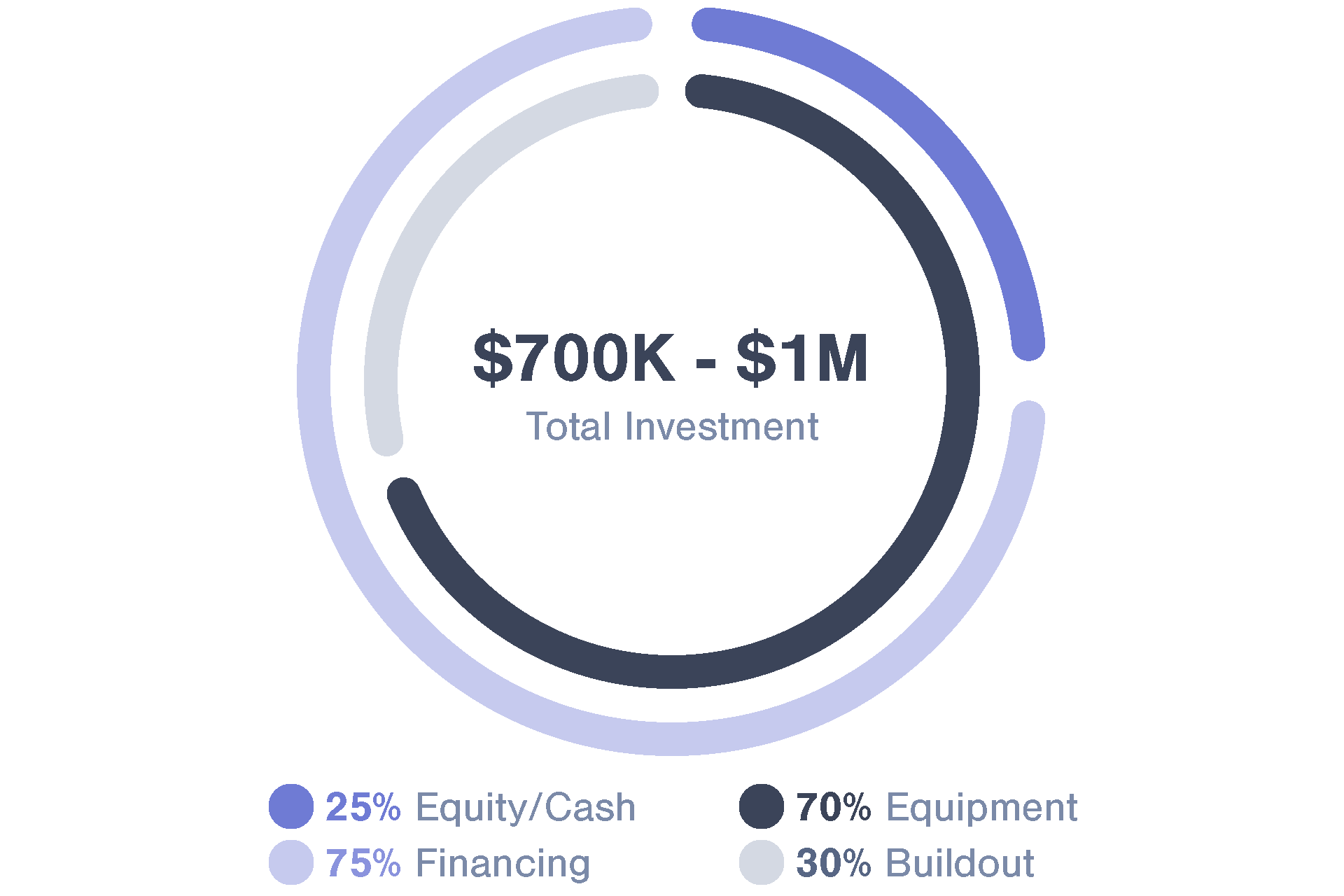
The above estimates offer a realistic rough order of magnitude for planning purposes. You should still conduct your own research into actual figures and costs which may vary significantly depending on your geographic location, project size, and market-specific factors.
What's Included in Startup Costs Estimate
- Equipment package: Washers, dryers, payment systems, vending machines, and facility infrastructure
- Construction and buildout: Site preparation, utilities, interior finishing, and compliance modifications
What's Not Included
- Real estate costs: Leasing costs (or mortgage payments on purchased property) are treated as operating expenses. You can research local rental rates for commercial spaces on platforms like Crexi or LoopNet.
- Working capital: Plan on starting with sufficient reserves to cover at least 4 months of operating expenses to carry you through the initial ramp period. This typically equates to around $50-80K, but can vary depending on your store's location and scale.
- Professional fees: Typically these are fees you pay to your accountant, attorney, architect, broker or consultant
- Project-specific miscellaneous items: Additional items you'll need to consider, buy and install prior to grand opening - security systems (cameras, emergency lighting, alarms), operational items (laundry carts, trash cans, storage, cleaning equipment), customer amenities (seating, folding tables, children's area items), computers, Wi-Fi, POS/payment systems, signage & branding, office/cleaning supplies & consumables.
Additional Items to Consider When Budgeting and Formulating Your Business Plan
Beyond the major equipment and construction costs, several additional factors require careful consideration for a robust project schedule and accurate budget. It is absolutely essential (we can't stress this enough) to perform thorough due diligence early on during site evaluation. This will ultimately save you a lot of headache, delays and unforeseen costs once the project is under way.
It's also important to note that many commercial real estate brokers, dedicated business brokers and even general contractors lack the laundromat-specific expertise necessary to provide guidance on infrastructure requirements and various nuances of fitting out a space for a laundromat.
Here are just a few big-ticket items you should spend time researching and discussing with your contractor and your partner or advisor:
- Permitting and compliance: Construction and environmental permits, business licenses, and ADA accessibility modifications. Permitting remains one of the leading sources of project delays and requires effective coordination between the contractor and your city agencies. In some cases, consider working an expeditor to push things along.
- Infrastructure modifications: Electrical service upgrades for high-voltage equipment requirements
- Plumbing and drainage systems: Adequate water pressure and waste management for commercial laundry operations
- HVAC systems: Climate control for customer comfort and equipment performance
- Technology integration: Modern payment systems, operational monitoring software, and customer management platforms
- Safety and security systems: Surveillance cameras, lighting, automated switches, and remote access controls
- Signage and branding: Exterior and interior visual identity elements
Who Is Your Customer?
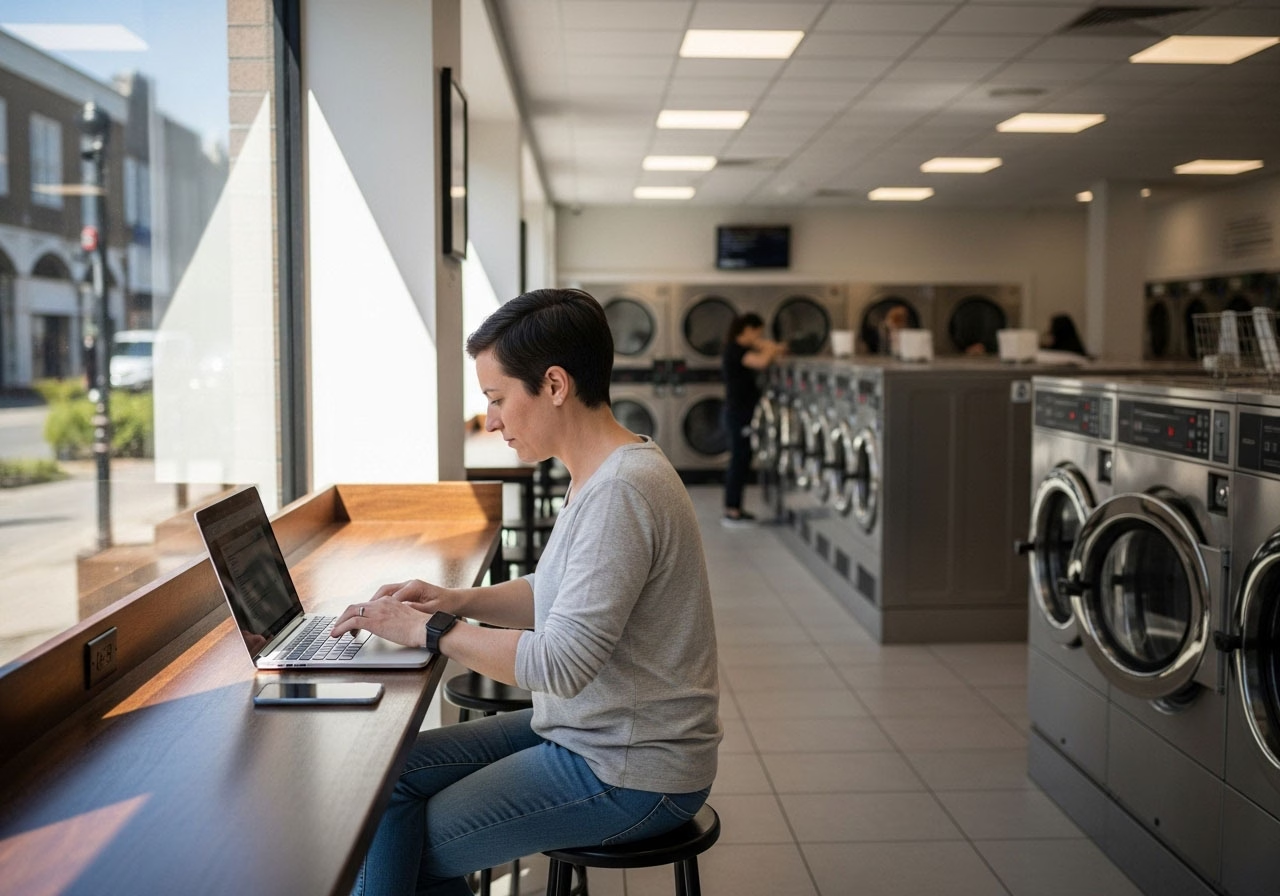
One of the most critical early decisions when starting a laundromat business is identifying your target customer. This choice fundamentally shapes every subsequent decision—from site selection and buildout design to equipment mix, service offerings, and pricing strategy.
The traditional perception that laundromats primarily serve low to middle-income families represents an outdated view of the industry. In many growing or densely populated cities (e.g. Austin, Dallas, Philadelphia, NYC, Chicago), many customers have substantial disposable income but lack in-unit laundry facilities or simply prefer to delegate this time-consuming task. Today's most successful laundromat operators recognize diverse market opportunities across multiple income levels.
Three Primary Strategic Paths
Traditional/Value-Focused
Price-conscious customers prioritizing affordability and basic reliability. Success through operational efficiency and competitive pricing.
Premium/Convenience-Focused
Affluent customers willing to pay more for superior service, convenience, and specialized care. Success through value-based pricing and premium convenience services like wash and fold or pickup and delivery.
Mixed-Market Approach
Serving both segments through varied service tiers. Requires sophisticated operational capabilities and clear positioning to avoid alienating either group or diluting your brand.
To understand who your customer is, start by pinpointing their typical household income, lifestyle habits and laundry frequency, value priorities (cost vs. time vs. quality of service), garment care needs (everyday wear vs. expensive items), willingness to pay for convenience services, etc.
Both traditional and premium strategies can generate excellent returns, but the key is making this decision early and maintaining strategic focus. Your customer choice directly influences location criteria, space design, equipment selection, service portfolio, and pricing approach. A well-executed strategy focused on any viable customer segment will consistently outperform an unfocused approach trying to serve contradictory needs simultaneously.
Selecting The Right Location Is A Science
Site selection represents one of the most critical decisions in starting a laundry business successfully. Before diving into specific location strategies, new owners should decide which market approach aligns with their risk tolerance and business objectives.
2 Strategic Paths: Competitive vs. Underserved Markets
Competitive Market Strategy
Enter established markets to capture share from existing competitors through superior equipment, service, and positioning. This approach assumes your new, well-equipped store can outperform established legacy stores and older underperforming competitors.
Underserved Market Strategy
Become the first or primary laundromat in an emerging area. While this offers less immediate competition and an opportunity to dominate a particular market, it carries considerably higher risk as market demand may be insufficient for sustainable, profitable operations. There may be reasons why no laundromats currently exist in the area. Prospective investors should consider the underlying market conditions before committing to underserved locations.
Regardless of which path you chose to pursue, new construction provides more flexibility for strategic positioning compared to acquiring existing locations, which marry you to that location's specific market dynamics, competitive landscape, and potentially aging or inadequate infrastructure unfit for modern needs.
The 20% Market Share Rule
If you are pursuing competitive markets, the 20% market share threshold may be a useful metric to help distill out risky investments. Here's what it means. If, in order to break even, a laundromat requires you to capture 20% or more of the customers in a given market, it may signal low customer demand or a saturated, competitive market, which can make it difficult to reach profitability. On the flip side, laundromats where you break even after capturing just 3-5% of the addressable market represent extremely attractive and potentially lucrative opportunities. In short, the less market share you need to capture to reach profit, the better.
This principle shifts focus from avoiding competition to strategically positioning within existing demand. Rather than seeking markets without competitors, identify markets where you can capture a small portion of an established customer base through competitive advantages.
Beyond Traditional Demographics
Standard demographic analysis—income levels, population density, apartment counts—constitute only about a third of the many factors that influence the performance of laundromat location. Sophisticated site search and evaluation will also incorporate one or more of the following:
- Traffic Pattern Analysis: Near real-time and aggregate foot traffic and vehicular movement data revealing typical customer flow patterns and trends over time
- Competitor Assessment: Comprehensive evaluation of existing laundromats, their equipment mix and quality, service levels, pricing, and market positioning
- Co-tenant Analysis: Store performance analysis and customer draw of neighboring businesses
- Infrastructure Evaluation: Technical assessment of electrical capacity, plumbing/sewer systems, HVAC capabilities, etc.
- Development Pipeline Review: Understanding of the residential, commercial, and transportation project pipeline and current/planned amenities that may affect future market dynamics
This new data-driven approach represents a significant leap over the static, outdated census-level statistics, enabling more precise assessment of current market conditions and more effective risk management.
Space Planning, Equipment Mix, and Construction
After securing an optimal location, you'll want to shift gears to equipment selection and layout planning. The goal extends beyond simply maximizing machine count. You'll want to balance revenue potential per square foot with optimizing layout for efficient operations and pleasant customer experience.

High-Impact Equipment Decisions
Large-Capacity Machines (80-135+ pounds)
These typically command premium pricing. Many customers frequently opt for large machines to do their entire load in a single cycle, even if the machine capacity substantially exceeds load size. They also allow you to take on bulky items and include commercial and consumer wash-dry-fold services in your offering.
High-Speed Extraction Washers
Advanced spin cycles with speeds up to 450G reduce drying time, saving customers money while reducing your energy & utility costs and allowing more turns per day, increasing a machine's revenue potential.
Specialty Equipment
Pet wash stations, oversized dryers, and express wash options create additional revenue streams.
Optimizing Equipment Mix
Offer a well-balanced selection of machines to serve diverse customer needs and capacity to manage different load sizes and bulky items like comforters, sleeping bags, and commercial loads.
Smart Laundromat Operators Leverage Tech
Integrate the latest laundromat technologies into your new laundromat business for a competitive edge. Your laundromat's entire connected ecosystem can analyze mountains of data, provide operational insights, inform pricing strategies and ultimately drive profitability.
Advanced Payment Systems
Card and mobile payment options eliminate coin & cash risks and payment barriers while generating valuable customer data for pricing optimization and marketing insights. Dedicated laundromat cards further improve visibility into your customer base.
Operational Monitoring
Connected machines provide real-time performance data, energy/utility consumption metrics, predictive maintenance alerts, and usage pattern analysis. This enables remote monitoring across multiple locations and data-driven decisions on pricing, operations, and customer experience improvements.
Customer Engagement Platforms
Mobile applications with cycle notifications, loyalty programs, and service booking capabilities enable premium service offerings and improve user experience, which in turn boosts customer retention and lifetime value.
These capabilities are much more than a mere convenience factor. They provide the operational intelligence necessary for strategic decision-making in today's competitive environment and have a clear, measurable impact on your bottom line as a laundromat business owner.
Construction and Development Coordination
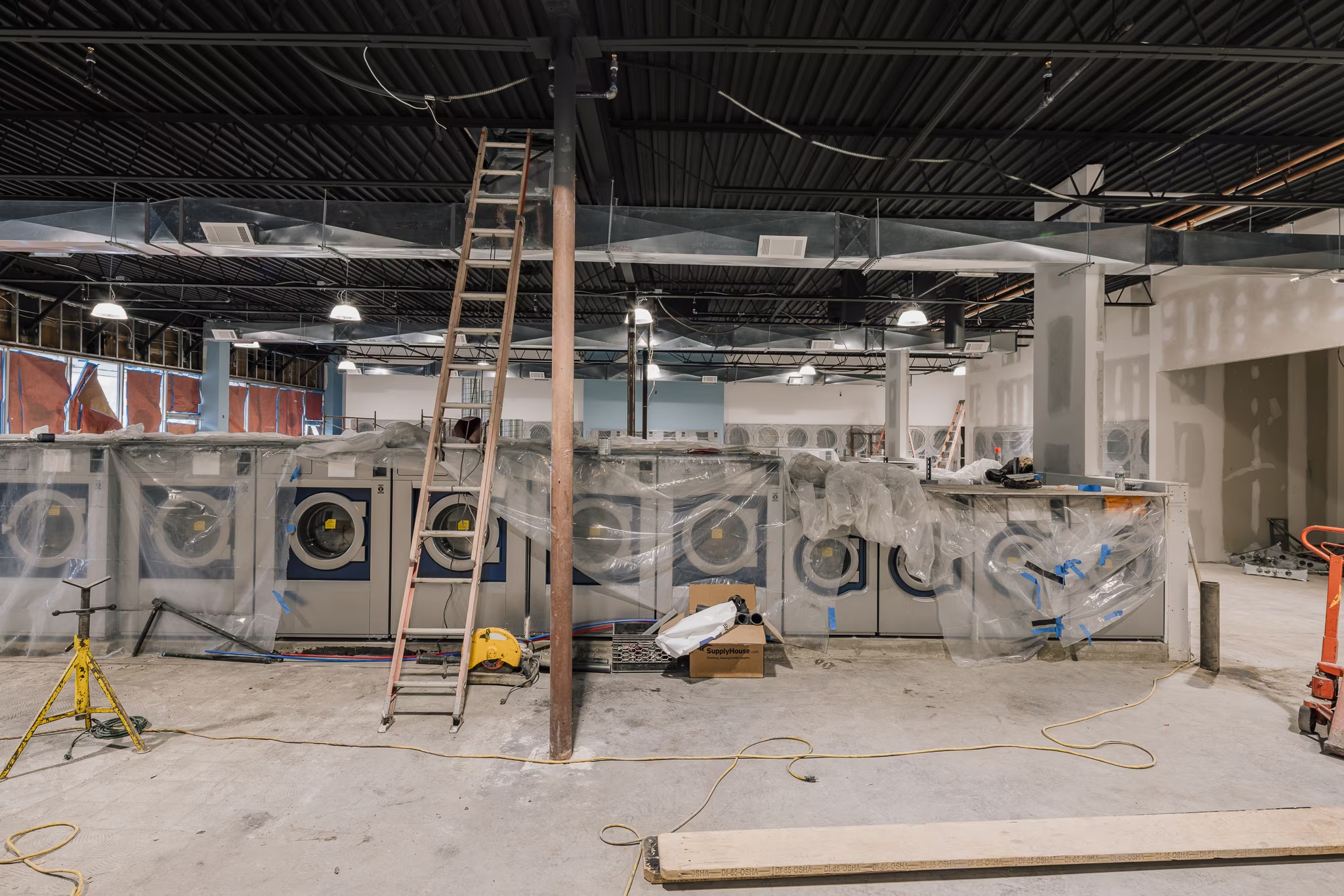
Successful laundromat development requires coordinated execution across multiple specialties and stakeholders. Poor coordination between these moving parts regularly leads to timeline delays, budget overruns, and performance compromises:
- Vendor Management: Synchronizing real estate brokers, general contractors, equipment suppliers, technology providers, and municipal agencies
- Timeline Dependencies: Equipment delivery coordinated with construction milestones, permit approvals aligned with installation schedules
- Budget Control: Minimizing change orders and limiting scope creep through integrated planning and clear specifications
- Quality Assurance: Ensuring all systems integrate properly and meet operational requirements before opening
The complexity of managing these interdependencies often justifies working with experienced development partners who understand laundromat-specific requirements and can prevent costly coordination failures.
Typical Timeline
Starting a laundromat business requires a structured, multi-phase approach spanning approximately eight months from planning to opening: